
January 21, 2026
Article
Travel Agency Workflow: How AI Workspaces Improve Quoting, Follow-Ups, and Sales Execution
If your agency is losing deals, it’s often not because you’re too expensive. It’s because your workflow can’t keep up with how travelers buy today: fast questions, multiple itinerary changes, last-minute deadlines, and constant back-and-forth.
Most teams feel the symptoms first:
• Response times slip from minutes to hours
• Quotes live in PDFs, email threads, or someone’s laptop
• Follow-ups depend on memory, not a system
• Owners and managers can’t see what’s happening until it’s too late
• Tools multiply, but clarity doesn’t
That’s a workflow problem. And once lead volume grows, workflow becomes the difference between an agency that scales and an agency that stays stuck firefighting.
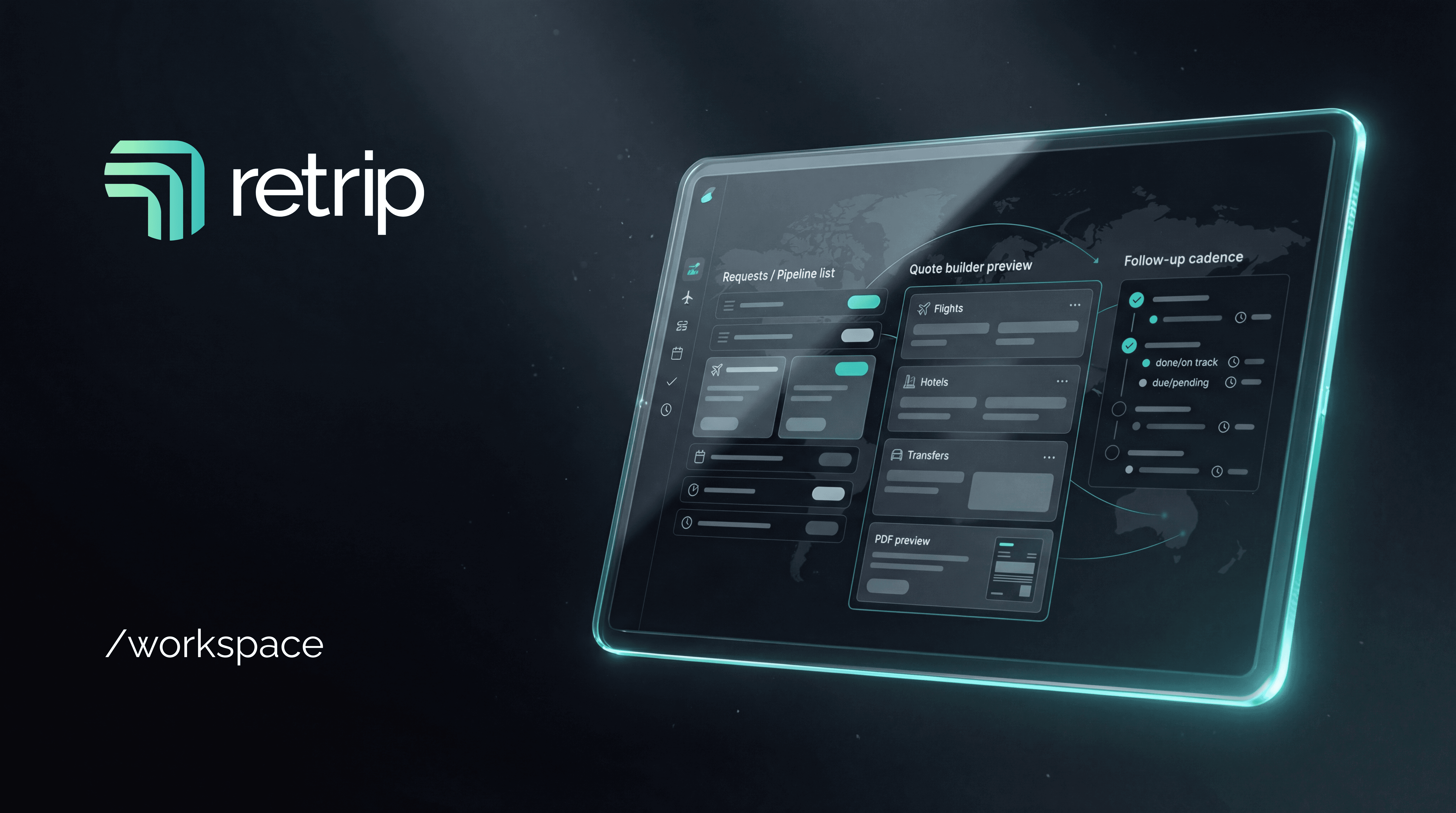
This article breaks down how travel agencies typically operate, the hidden costs of fragmented tools, and how purpose-built AI workspaces are starting to act as an operational layer—helping teams turn requests into clean quotes faster and keep follow-ups visible and consistent. A practical reference point is Retrip Workspace, which is designed to help agencies organize requests, create quotes, and manage follow-ups from one workspace.
How most travel agencies manage their workflow today
At low to moderate volume, the default stack looks familiar:
• WhatsApp (or Instagram DMs) for inquiries and quick questions
• Email for confirmations, attachments, and supplier messages
• Excel or Google Sheets to track leads and bookings
• PDFs or Word documents for quotes
• Manual follow-ups with reminders or sticky notes
• A shared inbox, maybe, if the team is disciplined
This setup “works” because it matches how agencies grew historically: relationship-based selling, highly experienced agents, and a manageable number of active quotes at any one time.
Why this setup works at low volume
When the team is small and everyone can “keep it in their head,” the process feels flexible:
• Each agent knows their own pipeline
• Customer context is in the chat thread
• Quotes are handled one by one
• Urgent items get attention because someone is always watching the inbox
If you’re handling a limited number of inquiries per day, you can patch gaps with effort and experience.
Why it breaks as soon as demand grows
The moment lead volume increases, or the agency adds more agents, the same stack starts to fail:
• Requests and details get scattered across channels and files
• A quote gets revised three times but only one version is easy to find
• A client asks “Did you include transfers?” and the agent has to re-open files and scroll through threads
• Follow-ups become inconsistent because they’re not visible to anyone else
• Managers can’t coach the team because pipeline data is incomplete or outdated
At that point, “more leads” doesn’t automatically mean “more sales.” It often means more chaos.
The hidden cost of fragmented tools
Fragmentation isn’t just annoying. It creates measurable losses, especially in travel agency operations, where visibility and repeatability matter.
Lost sales due to slow replies
Speed wins. When a traveler sends an inquiry, they usually send it to more than one agency. If your reply arrives after a competitor’s, you’re often out of the game before you even quote.
Slow replies typically come from micro-delays:
• The inquiry arrives in one place, but the agent is working in another
• Information gets copied into a sheet (or multiple sheets)
• Quote details are re-assembled from old templates
• The team isn’t sure who “owns” the lead
• Follow-up timing is guessed, not planned
Missed follow-ups that quietly kill conversion
Most lost deals aren’t lost because the client said “no.” They’re lost because the agency stopped following up at the right moment.
When follow-ups are manual:
• Hot leads cool down
• Agents focus on whoever is currently messaging them
• Pipeline looks “fine” until the month ends and targets aren’t met
• Owners only discover gaps after revenue is already lost
Lack of visibility for owners and managers
If visibility depends on asking agents for updates, you don’t have visibility—you have status meetings.
Owners and managers need to know:
• How many active quotes are in progress
• Which ones are stuck and why
• Whether follow-ups are happening on time
• Where conversion drops (request → quote sent → decision)
Without system-level visibility, scaling becomes guesswork.
Stress on sales teams and the inability to scale
Fragmentation turns senior agents into human routers: moving information between tools instead of selling travel.
As volume grows, agencies often “solve” this by hiring more people. But if the underlying workflow is broken, more headcount increases coordination cost. The team spends more time syncing and less time converting.
Why speed and organization matter more than price
Many agencies default to competing on price because it feels tangible. But travelers don’t only compare cost—they compare confidence.
Why agencies lose deals even when price is competitive
You can be the best-priced option and still lose if:
• The quote is unclear or missing key details
• The client has to ask too many follow-up questions
• Response times are slow after the first message
• Itinerary changes aren’t handled smoothly
• The traveler feels they’re “chasing” the agency
In practice, clients pay for certainty. They want to feel the trip is handled.
How response time and clarity influence trust
Two agencies can quote the same trip. The winner is often the one that:
• Replies quickly
• Presents options clearly
• Explains trade-offs (refundability, baggage, location, timing)
• Follows up at the right moment without being pushy
That’s execution. And execution is a workflow advantage.
Modern agencies compete on execution, not discounts
Discounts reduce margin. Workflow improves margin.
A better workflow means:
• Faster time-to-quote
• More consistent follow-up
• Higher conversion without lowering price
• Less reliance on “hero agents”
• Easier onboarding and quality control
What is an AI workspace for travel agencies?
An AI workspace is not a generic CRM. It’s a centralized place where the agency’s quoting work and follow-up work stay connected, so the team can move faster, reduce mistakes, and keep each quote on track.
Retrip Workspace sits exactly in that lane: it helps agencies organize requests, build quotes, and manage follow-ups from one workspace, with the goal of faster replies and more bookings.
How an AI workspace differs from traditional CRM tools
Traditional CRM platforms were built for generic sales: stages, deals, notes, tasks.
Travel agencies have a different reality:
• The “product” is an itinerary that changes
• The quote is the center of the sales process
• Revisions happen constantly
• Deliverables need to look professional (fast)
That’s why many agencies search for travel-specific CRM alternatives, not because CRMs are “bad,” but because they don’t map cleanly to travel quoting and iterative back-and-forth.
The operational core: what a purpose-built workspace actually does
To stay faithful to what Retrip Workspace is (and is not), the practical operational model is:
Keep requests, drafts, and quotes organized in one place
Convert messy trip inputs into structured services quickly
Generate a clean, professional PDF without manual formatting
Make follow-up and ownership visible across the team
The 3-step workflow (a concrete example)
Retrip Workspace describes a simple workflow that matches real agency work:
Set up your trip
Choose trip type, dates, routes, and passengers.Add services in any format
Write or paste text, screenshots, or docs; the system interprets and structures services automatically.Customize & download the PDF
Select how the trip details should appear; the quote is instantly formatted and ready to send.
Important detail: this is not an omnichannel inbox. The operational win comes from centralizing the quote work and its follow-up once you’re assembling the trip, using whatever inputs you already receive (text, screenshots, docs) as the raw material.
Traditional tools vs. a single workspace (what changes in practice)
Fragmented tools vs. one place to work
With fragmented tools:
• WhatsApp holds context
• Sheets hold partial tracking
• PDFs hold the quote
• Email holds supplier confirmations
• Nothing connects cleanly
In a workspace model, the agency’s quoting work lives in one place, so the team spends less time searching and reformatting and more time responding and closing.
Manual follow-ups vs. team-visible follow-up
Manual follow-up is fragile. It depends on:
• Individual habits
• Memory under pressure
• Personal task lists no one else can see
A purpose-built workspace makes ownership and follow-up visible across the team. Retrip’s framing is “manage follow-ups from one workspace” and “clear team follow-up,” with visibility into who created each quote and what it includes.
“Hero agents” vs. system-based operations
Hero agents can carry a lot, until they can’t.
System-based operations mean:
• The agency’s output is less dependent on a few individuals
• Handoffs are smoother
• Quote quality becomes more consistent
• Managers can actually see work in progress and coach accordingly
This is the real reason workflow matters: it turns execution into a repeatable capability.
Choosing the right travel agency workflow software
If you’re researching travel agency quoting software or broader workflow platforms, focus on operational fit, not feature lists.
Is it designed around quoting, not generic deal tracking?
The quote is the artifact that moves the sale forward.Can your team produce clean PDFs fast (without formatting chaos)?
Professional PDFs in minutes should be real, not aspirational.Does it help your team stay organized across requests, drafts, and quote versions?
“One space for all your quotes” should be tangible in daily work.Is follow-up management and ownership visible across the team?
Look for team visibility, not just personal reminders.Can new agents get value immediately?
If adoption requires heavy training, it won’t survive peak season.
Conclusion
Travel agencies rarely lose sales because of price alone. They lose sales because the work behind the scenes is fragmented:
• Quotes take too long
• Input is scattered
• Follow-ups are inconsistent
• Managers can’t see what’s happening in time to help
• Scaling defaults to hiring instead of improving the system
The agencies that win over the next few years won’t be the ones that discount harder. They’ll be the ones that execute better—faster response, clearer quotes, consistent follow-up, and operational visibility.
If you want to see what an execution-focused workflow looks like in practice, explore Retrip Workspace and start a free 15-day trial.